
Low maintenance and beautiful are not natural opposites in garden design, but achieving both simultaneously requires more thought upfront than most gardens receive. The typical approach, choosing plants that appeal at the time and arranging them without a coherent structure, produces a garden that looks reasonable initially and becomes increasingly difficult to manage as plants mature, spread, and compete.
A genuinely low maintenance family garden that remains attractive across all seasons is the result of deliberate decisions made at the planning stage. Once those decisions are in place, the ongoing effort required is minimal and the results are consistent.
Start With Structure, Not Plants
The most common planning mistake in garden design is starting with plant selection. Plants are the most appealing part of the process, they are what you see at a nursery, what you find in inspiration images, and what most people think of when they imagine their finished garden. But plants without underlying structure are almost always disappointing in the medium term.
Structure in a garden comes from hard landscaping: the paths, paving, edging, walls, raised beds, and built elements that define the shape of the space and remain constant regardless of what is growing. Getting this right first means that even when plants are young and have not yet filled their allotted space, the garden has form and legibility. It also means that as plants mature, they fill a structure rather than sprawling without definition.
Hard landscaping in a family garden needs to account for the reality of how the space will be used. Paths wide enough for children to run without stepping on plants. Surfaces durable enough to handle heavy foot traffic and outdoor furniture. Edging robust enough to contain lawn and prevent it from encroaching into garden beds. These are practical specifications that aesthetic ones must sit within.
Choosing Plants for Longevity and Resilience
Once structure is in place, plant selection becomes considerably easier because each planting area has defined dimensions, a known light profile, and a clear role in the overall design. Choosing plants that are genuinely suited to those conditions, rather than ones that will struggle and require constant intervention to survive, is the single most impactful decision in creating a low maintenance garden.
Resilient plants, those that establish quickly, tolerate a degree of neglect, and hold their form without constant pruning, are the backbone of any low-effort garden. Structural plants with year-round interest, ground covers that suppress weeds effectively, and seasonal performers that cycle through flowering without requiring deadheading or division make up the core planting palette.
Avoiding plants with high water requirements, susceptibility to common pests, or a tendency to spread aggressively simplifies the ongoing management of the garden enormously. One problem plant in a border creates more work than all the well-chosen plants around it.
Lawn Management Made Honest
Lawn is the most maintenance-intensive element in most residential gardens, and most homeowners significantly underestimate how much time it takes to keep in good condition. Mowing, edging, fertilising, aerating, and managing weeds and bare patches are all part of the ongoing commitment that a lawn requires.
The first question to ask is whether the lawn you have is the right size and shape for your household. An expanse of lawn that nobody uses is pure maintenance burden. A well-sized lawn that children actually play on, that adults use for outdoor activities, and that is proportionate to the rest of the garden is worth the effort it requires.
Simplifying the shape of the lawn reduces mowing time significantly. Complex curves and tight corners that require repositioning the mower repeatedly can be eliminated by straightening edges and removing awkward extensions. Selecting a grass variety appropriate to the sun and soil conditions of the specific site also dramatically affects how much supplemental irrigation and intervention is needed.
Play Equipment as a Garden Feature
In a family garden, play equipment is not separate from the garden design. It is part of it, and how it is integrated affects both how the garden looks and how functional the play space is.
Equipment that is well-sited, with appropriate surface treatment underneath, adequate clearance around it, and a considered relationship to the rest of the garden, becomes a feature rather than an intrusion. Equipment that has been placed without thought looks like an afterthought and disrupts the cohesion of the rest of the design.
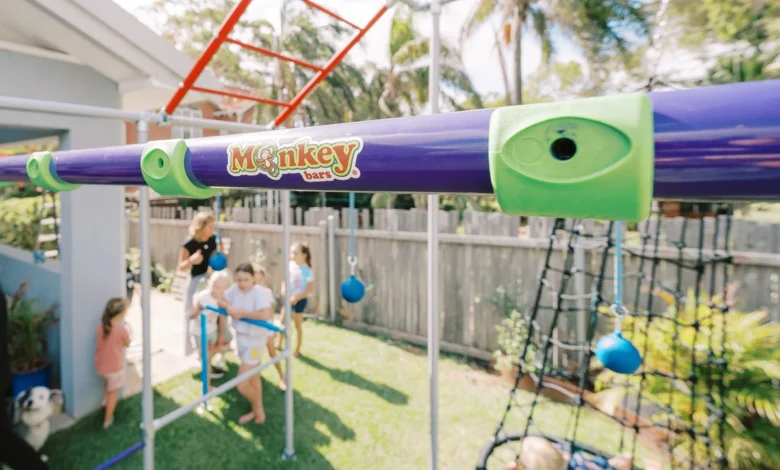
Choosing equipment that is built to a quality that holds up to years of outdoor exposure without significant deterioration is also a garden design consideration as well as a practical one. Equipment that fades, rusts, or degrades quickly creates ongoing maintenance and an increasingly tired aesthetic in the garden. Well-designed Monkey Bars structures with weather-resistant materials and finishes integrate into the garden without creating an ongoing maintenance obligation, which is exactly what a low maintenance design approach requires.
Mulch as a Management Tool
Mulch is one of the most underutilised tools in low maintenance garden management. Applied correctly, it suppresses weed germination, retains soil moisture, moderates soil temperature, and gradually improves soil structure as it breaks down. The reduction in weeding time alone from a properly mulched garden is significant.
The key variables are depth and type. A minimum of 75 millimetres of organic mulch is needed to effectively suppress weeds. Less than this allows enough light through for weed seeds to germinate. The type of mulch affects both aesthetics and the rate of breakdown. Coarser mulches like wood chip break down slowly and require less frequent top-up. Finer mulches decompose faster and contribute more quickly to soil improvement but need refreshing more often.
Keeping mulch away from direct contact with plant stems and tree trunks prevents moisture-related disease and collar rot. A small collar of bare soil around each plant, with mulch applied to the surrounding area, provides the weed suppression benefit without the plant health risk.
Irrigation Takes the Effort Out of Watering
A simple drip irrigation system on a timer removes the most time-consuming recurring garden task from the maintenance schedule entirely. Drip systems deliver water directly to the root zone of plants, reducing evaporation, preventing fungal issues associated with overhead watering, and ensuring plants receive consistent moisture even during busy periods when manual watering gets missed.
The investment in a basic system is modest and the payoff is immediate. Plants establish faster, require less intervention during dry periods, and are healthier overall because their water supply is consistent rather than irregular. For a family garden where time is genuinely limited, automated irrigation is one of the highest-return improvements available.